
Nu-Isoleren Logo
Roof insulation

What is the best roof insulation? Materials, thickness and applications compared

Compare glass wool, PIR and EPS roof insulation and learn how insulation thickness, thermal resistance and roof construction determine the right solution.

Updated on 16 October 2026

What is the best roof insulation? Materials, thickness and applications compared

Choosing the best roof insulation involves more than comparing insulation thickness. The existing roof structure, available space, use of the loft, required thermal performance and installation method all affect the final choice.

Glass wool, PIR insulation boards, EPS and other insulation materials each have different characteristics. A solution that works well for one pitched roof may therefore not be the best option for a flat roof or loft floor.

In this guide, we compare the main roof insulation materials, explain insulation thickness and thermal performance, and look at insulation from the inside and outside.

What is the best insulation for a roof?

There is no single insulation material that is automatically the best choice for every roof.

For a pitched roof with sufficient space between timber rafters, a flexible material such as glass wool can be particularly suitable.

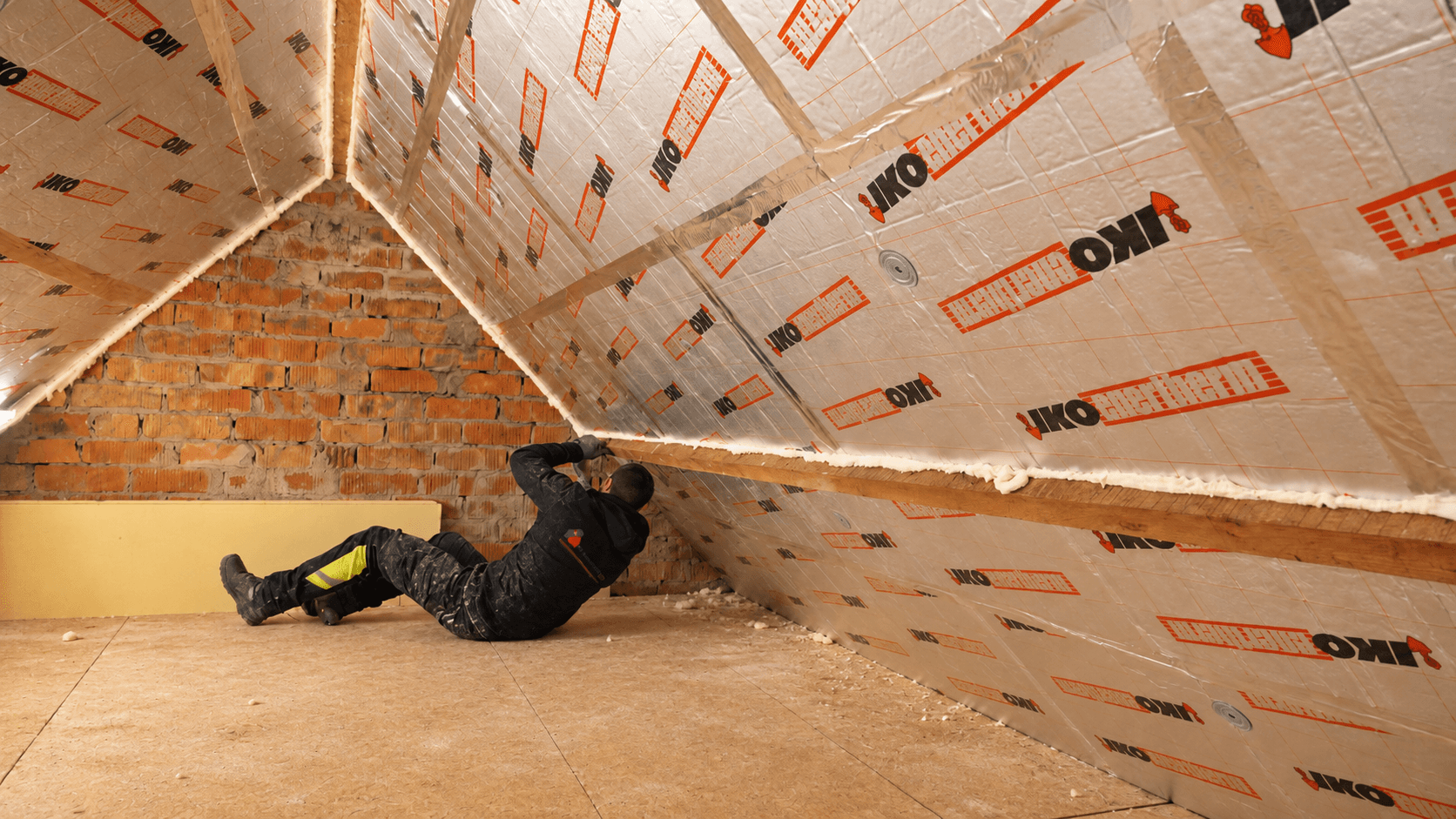
Where available space is more limited, PIR insulation boards can provide strong thermal performance within a relatively small thickness.

If a loft remains unheated and is not used as living space, insulating the loft floor may sometimes be more appropriate than insulating the complete roof slope.

The best roof insulation therefore depends on the existing construction, available space and intended use of the roof space.

Which materials can be used for roof insulation?

Several insulation materials can be used in roofs.

Glass wool is a flexible insulation material that fits well between timber rafters and framing. It provides thermal insulation and can also contribute to acoustic comfort.

PIR insulation consists of rigid insulation boards. Its relatively low thermal conductivity means that strong thermal performance can be achieved with a more limited thickness.

EPS can be used for a range of insulation applications. Nu-Isoleren uses EPS for certain loft-floor constructions.

Other materials such as rock wool and bio-based insulation products are also available. The appropriate material always depends on the construction in which it will be installed.

Glass wool or PIR: which roof insulation should you choose?

Glass wool and PIR can both be used for roof insulation, but their properties and applications differ.

Glass wool is flexible and can fit closely between timber rafters. Its fibrous structure can also improve acoustic comfort.

PIR is supplied as a rigid insulation board and provides strong thermal resistance relative to its thickness. This makes it particularly useful where the available insulation depth is limited.

If sufficient space is available between the roof timbers, glass wool can be a practical solution. Where build-up depth is limited, PIR may be more suitable.

The existing roof structure ultimately determines which solution is appropriate.

How thick should roof insulation be in Belgium?

Belgium does not have one universal rule stating that roof insulation must always be a fixed number of centimetres thick.

Thermal requirements are mainly expressed through R or Rd values, which describe thermal resistance, and U-values, which describe heat transmission through the complete construction.

The requirements also differ between the Belgian regions.

In Flanders, newly installed roof or loft-floor insulation must currently achieve an Rd value of at least 4.5 m²K/W to meet the insulation requirement of Mijn VerbouwPremie. Where EPB requirements apply to renovation works, roofs are generally subject to a maximum U-value of 0.24 W/m²K.

In Wallonia, roof or loft insulation eligible under the current Prime Habitation scheme must achieve a thermal resistance of at least R 5.00 m²K/W. Walloon PEB requirements also use a maximum roof U-value of 0.24 W/m²K in the relevant renovation context.

The actual insulation thickness depends on the material's lambda value. For example, an insulation product with λ 0.040 W/mK requires approximately 18 cm to reach Rd 4.5 m²K/W and approximately 20 cm to reach R 5.0 m²K/W. A material with a lower lambda value can achieve the same thermal resistance with less thickness.

Roof insulation thickness should therefore always be determined using the actual insulation product and the requirements that apply to the project.

Which insulation is suitable for a pitched or flat roof?

Pitched roofs and flat roofs require different insulation build-ups.

In an existing pitched roof, insulation is often installed between or below the existing timber structure. Flexible glass wool is particularly suitable for fitting between rafters, while PIR boards can also be used depending on the roof build-up.

With a flat roof, the load-bearing structure, vapour control layer, insulation and waterproofing system must be considered together.

The existing roof construction should therefore be examined before selecting the insulation material.

Should a roof be insulated from the inside or outside?

Insulating a pitched roof from the inside is often suitable when the existing roof covering is still in good condition.

The insulation is installed from the loft or room below the roof, for example between the existing rafters.

External roof insulation is more commonly considered when the roof covering is also being replaced. The insulation can then be installed above the existing roof structure, making it possible to create a more continuous insulation layer.

The right method depends on the condition of the roof covering, available internal space, existing construction and planned renovation work.

A technical assessment should therefore be carried out before choosing between internal and external roof insulation.

Should you insulate the roof or the loft floor?

The answer largely depends on how the loft is used.

If the loft is heated or used as a bedroom, office or other living space, insulating the roof slopes is normally the logical choice because the loft remains inside the thermal envelope.

If the loft remains unheated and is mainly used for storage, insulating the loft floor may be more efficient. The heated volume of the home is then kept smaller.

Nu-Isoleren can use EPS for certain loft-floor constructions. The existing floor structure should always be assessed before selecting the insulation system.

Which roof insulation is right for your home?

Choosing the right roof insulation depends on several factors:

• roof type and existing construction
• available insulation depth
• thermal conductivity and required thermal resistance
• use of the loft
• internal or external installation
• airtightness and moisture control
• energy requirements that apply to the project

Insulation should therefore not be selected on thickness alone.

Glass wool can work particularly well between timber rafters, while PIR can offer strong thermal performance where space is limited. In some unheated lofts, insulating the loft floor may be a more appropriate solution.

Nu-Isoleren assesses the existing construction before recommending the insulation material and installation method.

Learn more about our roof insulation service or request a free quotation.

Ready to improve your home?

Request a non-binding quote and discover what we can do for your home.