Nu-Isoleren Logo
INSULATION MATERIAL

PIR insulation boards for roof insulation

PIR is a rigid insulation board with strong thermal performance. Nu-Isoleren uses PIR insulation from IKO for roof constructions where high insulation performance, dimensional stability and a relatively limited insulation thickness are important.

PIR insulation boards for roof insulation

PIR stands for polyisocyanurate and is widely used in construction as a rigid insulation board.

The material combines strong thermal performance with a relatively limited thickness, making it particularly useful where the available insulation space is restricted.

PIR boards are rigid and lightweight and can be used in different ways depending on the roof construction. Correct joints between the boards and careful detailing are important to minimise interruptions in the insulation layer.

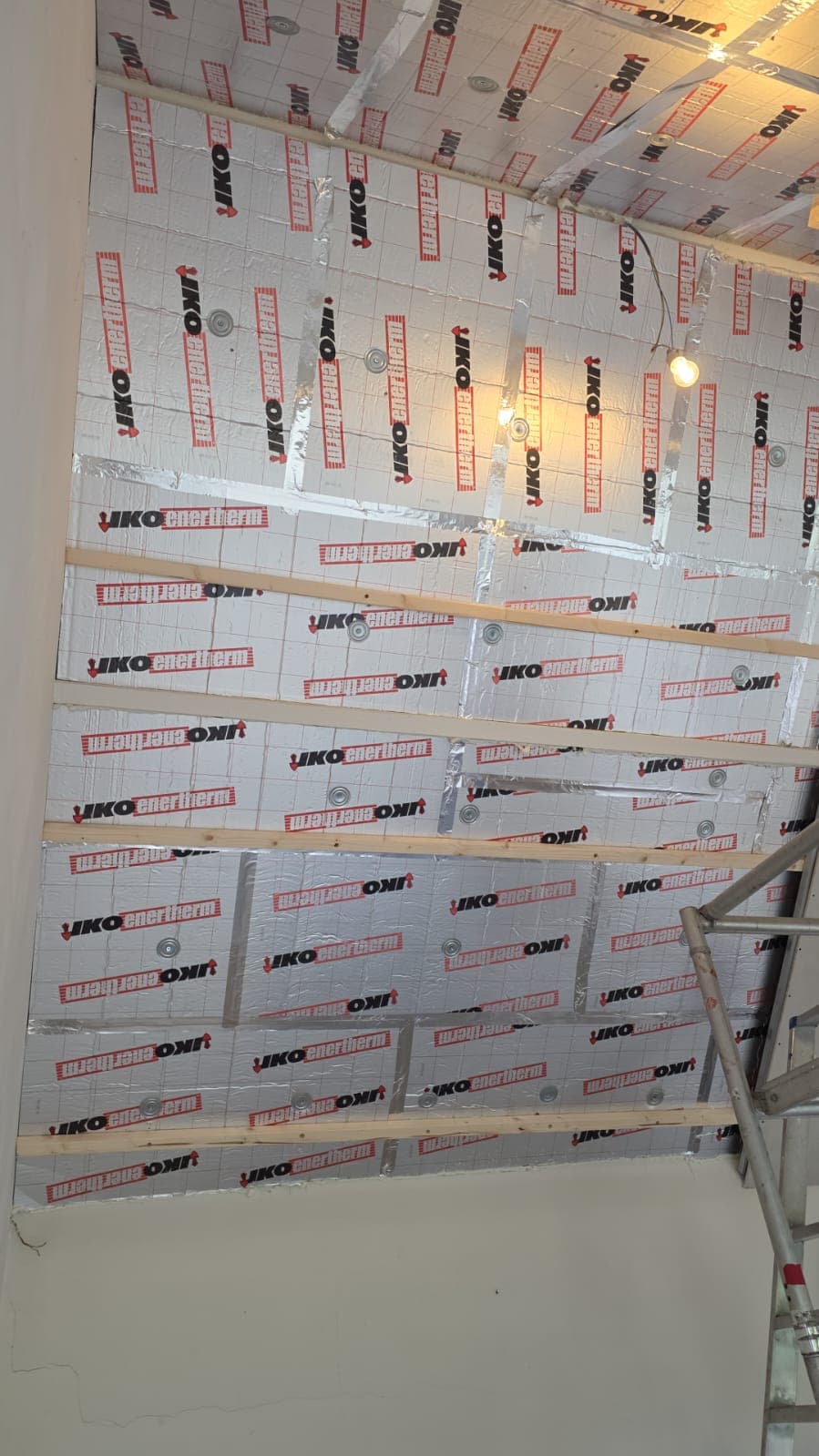
Nu-Isoleren uses PIR insulation from IKO. The IKO enertherm range contains different PIR solutions for different applications. The appropriate product and thickness depend on the roof construction and the required insulation level.

What are PIR insulation boards?

PIR is a rigid synthetic insulation material that is primarily supplied in the form of insulation boards.

The core of a PIR board consists of rigid polyisocyanurate foam with a closed-cell structure. This structure helps reduce heat transfer and gives the material its strong thermal performance.

PIR boards are available in different thicknesses, sizes and finishes. Depending on the product, the surfaces may have different types of facings.

The combination of strong thermal performance and limited thickness makes PIR particularly useful where the available space for insulation is restricted.

How does PIR insulate a roof?

The roof is an important part of a home's thermal envelope. If it is not sufficiently insulated, heat can be lost through the roof construction.

PIR boards form a rigid insulation layer that helps reduce heat transfer through the roof.

Because PIR offers strong thermal performance for each centimetre of material, a high insulation level can be achieved with a relatively limited thickness.

The final performance is not determined by the material alone. The thickness, installation quality, joints between the boards and the complete roof build-up are also important.

Why does Nu-Isoleren use IKO PIR?

For our PIR insulation work, we use IKO, a manufacturer offering a broad range of insulation products for different parts of a building.

The IKO enertherm range includes PIR insulation boards for applications such as flat roofs, pitched roofs, floors and walls.

These boards combine strong thermal performance with low weight and good dimensional stability.

The exact IKO enertherm board and thickness used depend on the existing roof construction, the available space and the required insulation level.

What are the benefits of PIR insulation?

One of the main advantages of PIR is its strong thermal performance in relation to its thickness. This makes PIR particularly useful where the available insulation space is limited.

PIR boards are rigid and dimensionally stable. When installed correctly, they can form a stable and continuous insulation layer.

The material is relatively lightweight, which makes handling and installation easier.

PIR is also resistant to moisture absorption. Depending on the board and application, it can therefore be used in different parts of the building envelope.

The combination of insulation performance, limited thickness and stability makes PIR an attractive option for many roof constructions.

Strong insulation performance with limited thickness

The amount of available space for roof insulation is not always unlimited. The relationship between insulation performance and material thickness is therefore important.

PIR offers strong thermal performance per centimetre of insulation. This means that a high insulation level can often be achieved with a thinner layer than with some other insulation materials.

This can be useful when interior space needs to be preserved or when the existing roof construction only allows a limited insulation thickness.

The required thickness should always be determined according to the complete roof build-up and the required insulation performance. We therefore do not automatically use the same PIR thickness for every property.

How are PIR insulation boards installed?

Before installation, the roof construction is assessed to determine where the insulation layer should be positioned.

The PIR boards are cut to size and carefully fitted together. Good joints between the boards are important to minimise gaps and interruptions in the insulation layer.

Connections around beams, walls, roof windows and other construction details also need to be completed carefully.

Depending on the roof construction and insulation system, additional layers may be required for airtightness, vapour control and the final roof finish.

The exact installation method therefore depends on the existing construction and the insulation system being used.

PIR, moisture and dimensional stability

PIR has a closed-cell structure and absorbs relatively little moisture. This is an important property for insulation used within a building envelope.

The boards are also dimensionally stable. Maintaining their shape helps preserve good joints between the insulation boards over the lifetime of the construction.

However, moisture-resistant insulation does not replace a correctly designed roof build-up. Proper waterproofing, airtightness and vapour management remain important.

For this reason, we assess the entire roof construction rather than considering the insulation material in isolation.

Is my roof suitable for PIR insulation?

PIR can be used in different types of roof construction, but the most suitable solution depends on the existing situation.

The available space, roof build-up, condition of the structure, required insulation performance and planned finish all need to be considered.

PIR can be especially useful when strong thermal performance is required but the available space for the insulation layer is limited.

We therefore assess the property beforehand to determine which insulation build-up is technically and practically the most appropriate.

PIR or glass wool: which insulation should you choose?

PIR and glass wool can both be used for roof insulation, but they have different characteristics.

PIR is a rigid insulation board that provides strong thermal performance with a relatively limited thickness. It is dimensionally stable and suitable where a rigid insulation layer is preferred.

Glass wool is flexible and can be fitted easily between timber rafters or framing. It also offers good sound-absorbing properties.

Neither material is automatically the best choice for every home. The right solution depends on the roof construction, available space, required insulation performance and the planned finish.

Nu-Isoleren therefore assesses each project to determine whether PIR, glass wool or another insulation build-up is the most suitable option.

Ready to improve your home?

Request a non-binding quote and discover what we can do for your home.