
Nu-Isoleren Logo
Ceiling & Basement Insulation

Crawl Space Insulation with PIR Boards: How Does It Work?

Discover how PIR boards can improve insulation beneath your ground floor without necessarily removing the existing flooring.

Updated on 14 November 2026

Crawl Space Insulation with PIR Boards: How Does It Work?

Does your ground floor feel cold even when the heating is on? An uninsulated crawl space or basement beneath your home could be contributing to heat loss through the floor.

Fortunately, improving insulation does not always require removing the existing flooring. Where the space is accessible, rigid PIR boards can be installed against the underside of the floor.

At Nu-Isoleren, we have used PIR insulation boards from IKO for this type of project. Here is what homeowners should know about the method, its benefits and its limitations.

Should You Insulate the Crawl Space Ceiling or Ground?

There are two main approaches to insulating a crawl space: insulating the underside of the floor or insulating the ground within the crawl space.

Ceiling insulation creates a thermal barrier directly below the heated living space. It can reduce heat transfer through the floor while leaving existing flooring intact.

Ground insulation is sometimes considered where access is limited or the crawl space is too low for ceiling installation.

The most suitable approach depends on accessibility, moisture conditions and the construction of the building.

What Makes PIR Insulation Boards Suitable?

PIR, short for polyisocyanurate, is a rigid insulation material offering high thermal resistance relative to its thickness.

This makes it an attractive option where available headroom is limited.

PIR boards are lightweight, dimensionally stable and can form an effective insulation layer when installed on a suitable surface.

However, product selection matters. The boards, fixings and joints must be suitable for the existing structure and environmental conditions.

PIR insulation should not be exposed to prolonged water contact. Persistent dampness or leaks must be assessed before installation.

Want to learn more about the properties, thermal performance and applications of this material? Read our guide to PIR insulation boards.

A Real Crawl Space Insulation Project Using IKO PIR Boards

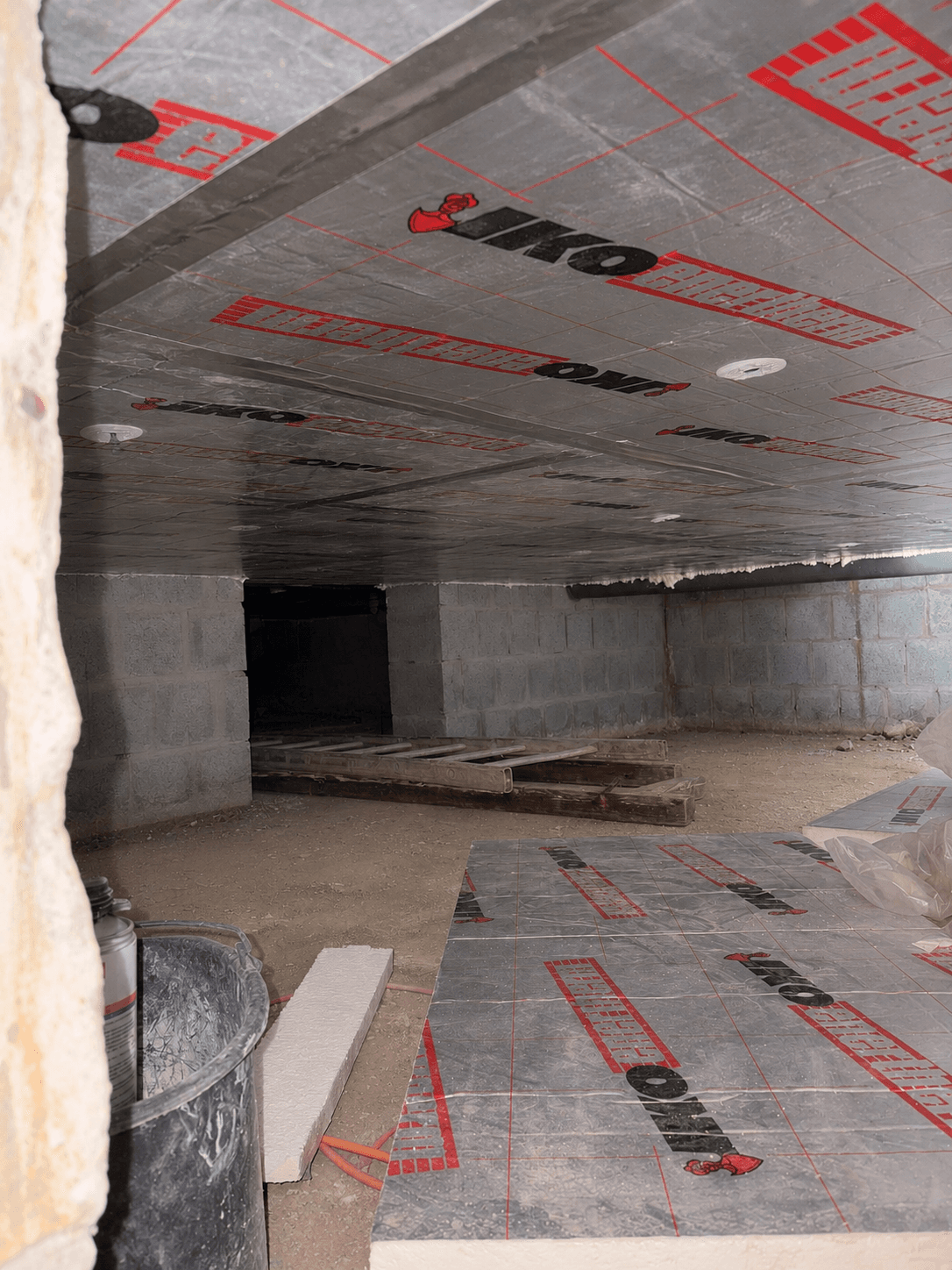
One of our projects involved installing IKO PIR insulation boards beneath an existing floor structure.

The project photograph shows aluminium-faced boards positioned against the crawl space ceiling, with additional boards still present in the work area.

The main advantage of this approach is that the insulation can be installed from below without necessarily removing the finished floor above.

Careful attention to board joints, perimeter connections and suitable fixing methods is essential.

The exact insulation thickness and product specifications depend on the requirements of each project.

How Is a Crawl Space Ceiling Insulated?

Installation begins with an assessment of the crawl space, including access, ceiling condition, pipes, moisture and ventilation.

Once a suitable insulation system has been selected, the PIR boards are cut to fit the available surface and installed according to the manufacturer's requirements.

Particular attention is given to joints, edges and penetrations where thermal bridges or air leakage could occur.

Existing ventilation provisions should not be blocked without an appropriate technical assessment.

What PIR Insulation Thickness Do You Need?

The required thickness depends on the product's declared thermal conductivity and the target insulation performance.

Thermal resistance is expressed as an Rd-value. Higher Rd-values indicate better resistance to heat transfer.

For example, 80 mm of insulation with a thermal conductivity of 0.022 W/mK provides a calculated thermal resistance of approximately 3.6 m²K/W.

This is an illustrative calculation rather than a specification for our photographed project.

Accessibility, moisture conditions, thermal bridging and fire safety requirements should also be considered.

Is PIR Crawl Space Insulation Right for Your Home?

Insulating the underside of your floor can be an effective way to improve thermal comfort without replacing the existing flooring.

The right solution depends on the condition and accessibility of your crawl space.

Considering crawl space or basement ceiling insulation? Nu-Isoleren provides insulation services across Flanders and Wallonia.

Contact our team to discuss your project and request a free, no-obligation quotation.

Ready to improve your home?

Request a non-binding quote and discover what we can do for your home.